
The Calendar Craze
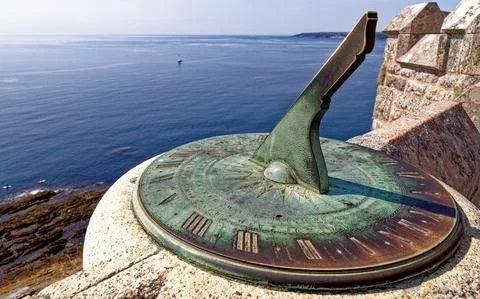
If you are seeing people keeping the biblical feasts but at different times, here’s why!
First of all, don't let this be a bad witness, the point is that people ARE seeking the ancient path and keeping the feasts. It's truly a revival!!
So here's the deal with the different times. Everyone desires to keep the calendar closest to the original reckoning of the Holy days. But historical evidence shows that centuries before Messiah, there was already controversy over three differing calendars-
Lunar/lunisolar calendar associated with Second-Temple Judaism.
Zadokite Priestly calendar associated with instructions found in Enoch, Jubilees, and the Dead Sea Scrolls.
The biblical understanding of an agricultural + lunar observation calendar.
I am going to take you though a brief breakdown of each of these with historical context. This is not an in-depth bible study, and I am not an expert on calendars. I personally prefer to keep the focus on the prophetic significance of the feast days but do share the desire to observe them as accurately to Yahuah’s original calendar as possible. These are my personal study notes that you can take as a jumping off point. I will link my preferred resources at the end.
Lunar Calendars
Calendars that use the moon as the chief time-keeper are typically Jewish calendars. These dates are usually what you'll see printed on your Gregorian calendar. This moon based calendar varies because some count the first day of the month as a sliver moon, some count it as no moon. The Jewish lunar calendar only accounts for 354 days a year, creating a necessity to add a 13th month to a year every so many years.
From the US Naval Observatory Astronomical Applications:
“The Jewish calendar that dates from the time of Hillel II (359 C.E., A.M. 4119) is an official calendar of the State of Israel, along with the Gregorian calendar. It is a lunisolar calendar based on computations rather than visual observations; sightings of the young crescent moon were used in ancient times.”
“The length of the synodic month used in the Jewish calendar is 29 days 12 hours 44 minutes 3⅓ seconds. The years in the Jewish calendar are counted in cycles of 19 years; of which, 12 years are common years of 12 months apiece, and 7 years are leap years containing 13 months. Altogether, the 19 year cycle has 235 months. Leap years are now fixed as the 3rd, 6th, 8th, 11th, 14th, 17th and 19th years of each cycle.” -US Navy, The Jewish Calendar
The major issue with this calendar is that there is no 13th month found anywhere in scripture. The bible counts time with 7 day weeks, 12 month years, 7 year jubilees, and 49 year cycles with the 50th year as a jubilee. We also see this 7, 7 week period + 1 day in the Feast of Shavuot aka Pentecost which literally means 50. But nowhere do we find a pattern or reckoning of time using 19 year cycles nor do we find a 13th month.
Months in the Bible:
1st Month: 22x 2nd Month: 10x 3rd Month: 5x 4th Month: 5x 5th Month: 8x
6th Month: 8x 7th Month: +30x 8th Month: 3x 9th Month: 6x 10th Month: 6x
11th Month: 3x 12th Month: 8x
1 Kings 4:7 Solomon had twelve governors over all Israel to provide food for the king and his household. Each one would arrange provisions for one month of the year.
Solar Calendar
Calendars that use the sun as the chief time- piece are known as Zadok calendars. The Zadok Priestly Calendar primarily uses 1 Enoch, Jubilees, and other documents found in the Dead Sea Scrolls, which align with and corroborate descriptions in the Torah, Prophets, and New Testament. There are still a couple of variations of dates on the Zadok calendar- people differ in how to begin the New Year according to the Spring Vernal Equinox and its relation to the moon and stars. But in general the Zadok calendar can track the sun's cycle through each of the 12 constellations, creating 12 months. Each month has 30 days and every 3rd month has a 31st day that is the transition into the next season. These are called New Moon festivals, as the moon bears witness of the new season. You'll find this aligned closely to the 4 seasonal dates on your Gregorian calendar, “first day of fall,” etc.
Paul says not to be judged for keeping festivals or new moons or Sabbaths; he's expressing 3 categories of appointed times/moedim: the weekly Sabbath, 4 seasonal new moon festivals, and 7 feast days. Remember- certain festivals are to be Sabbaths but that does not make them the weekly Sabbath. In the same regard, the 4 New Moons are moedim, but they are not the determining factor for counting feast days in their appointed months. The days are set and ordered.
Precise Zadok Calendar:
364 Days - 52 Weeks - 7 Days a Week
13 Weeks Per Season
12 Months of 30 Days
90 Days Per Season
4 New Moon or Seasonal 31st Days
Spring, Summer, Fall & Winter
(3rd, 6th, 9th, and 12th Months)
A Look At History
The Jewish calendar took influence from Babylon during Judah's exile in the 6th century BC. The names of months took on Babylonian names which related to pagan deities. Later, during the 4th-2nd century BC Greek incursion of Judah, the ordained Zadokite Priesthood was excommunicated and a new priesthood, known as the Hasmonean Dynasty, was set in place under the rule of Alexander the Great.
“A universal Greek education would ensure the inculcation of Greek values, and even native texts became increasingly modeled on Greek literature. Hellenization proceeded quickly and successfully as a policy because it required changes on the public and constitutional levels, while allowing native customs to be observed on a private level.”
While most of the covenant instructions were fought for, such as keeping the Sabbath, circumcision, and food laws, there were inadvertently compromises made for political leverage and control. The calendar was one such compromise. However, the legitimate but excommunicated Zadokite Priesthood left an abundant amount of evidence that would later be known as The Dead Sea Scrolls, found in the Qumran Valley in the 1940’s. Numerous copies of the book of Jubilees were uncovered which specifically details the original Hebrew calendar as well as various other texts of supporting evidence. For reference, there were 24 copies of Genesis found, 15 copies of Jubilees, and 11 copies of fragments of 1 Enoch found among the Dead Sea Scrolls. The texts providing a calendar are ‘forbidden’ for the Jews to read. Why? Because they reveal the illegitimacy of Rabbinic Judaism and the calendar that they hold so dearly.
Ezekiel 48:11 It will be for the consecrated priests, the descendants of Zadok, who kept My charge and did not go astray as the Levites did when the Israelites went astray.
Jubilees 6:35-37 For I know and from henceforth will I declare it unto thee, and it is not of my own devising; for the book lies written before me, and on the heavenly tablets the division of days is ordained, lest they forget the feasts of the covenant and walk according to the feasts of the Gentiles after their error and after their ignorance. For there will be those who will assuredly make observations of the moon -how it disturbs the seasons and comes in from year to year ten days too soon. For this reason the years will come upon them when they will disturb the order, and make an abominable day the day of testimony, and an unclean day a feast day, and they will confound all the days, the holy with the unclean, and the unclean day with the holy; for they will go wrong as to the months and sabbaths and feasts and jubilees.
Agricultural-Lunar Calendar
Looking just at the bible for an agricultural-lunar calendar, we can find that there are descriptions of months, New Moons, and agricultural seasons to observe the feast days. But, the reality is the 66-book canon does not give an explanation for how to observe the luminaries or count days. While the Torah provides terminology, it does not actually contain a calendar. The scriptures we have in the canon do however echo what was prescribed in Jubilees and Enoch. For example, the canon tells us to keep the New Moon festivals, but there are absolutely no instructions telling us what a New Moon is or when it is beyond one single hint in the Psalms-
Psalm 81:3 Sound the ram’s horn at the New Moon, and at the full moon on the day of our Feast.
2 Chronicles 8:13 He observed the daily requirement for offerings according to the commandment of Moses for Sabbaths, New Moons, and the three annual appointed feasts—the Feast of Unleavened Bread, the Feast of Weeks, and the Feast of Tabernacles.
Jubilees 6:21-22 “And at the new moon of the first month (31st of 12th month), and in the new moon of the fourth month (31st of 3rd month), and in the new moon of the seventh month (31st of 6th month), and in the new moon of the tenth month (31st of 9th month) are the days of remembrance and the days of the festivals in the four divisions of the years: written and ordained they are for a testimony until eternity. And Noah ordained them for himself as festivals for future generations, for on them there was to him a remembrance.”
The bible speaks of both New Moons and months. They do not mean the same thing. New Moons are “heads” of particular months, but not all month beginnings are New Moons. The Hebrew word for month is ‘chodesh’. The Hebrew word for moon is ‘yareach’. There are instances, depending on your translation, where verses that say ‘new moon’ will be italicized because they are not original. Some passages using ‘month’ were translated to English as ‘moon’ because of influence from the Jewish lunar calendar. You can see the word usage within an Interlinear, but the definition of the word month is completely separate from the word moon.
Leviticus 23:24 Speak to the Israelites and say, ‘On the first day of the seventh month you are to have a day of rest, a sacred assembly announced by trumpet blasts.
There is no indication in the Hebrew bible that a month is based off of the moon’s 28-day cycle. There is also no direct mention of a month being based off of the sun’s 30-day cycle. What we are told within the canon is that the sun is the ‘greater light’ given to rule days. The scriptures speak in terms of sunrise and sunset, evening and morning- those terms are utilizing the sun to determine the fullness of a day. The moon is observably inconsistent throughout the year. Depending on its season it may rise at 7pm, 11pm, 2am, or 7am. It does not provide us with the completeness of a day so how could we use it to count our days and determine our months?
Jubilees 6:27-30 “And they were raised into the tablets of heaven: thirteen sabbaths to each (New Moon), from one to another their remembrance, from the first to the second, from the second to the third, from the third to the fourth. And all the days of this commandment are fifty two sabbaths of days, and the whole year is completed. Thus it is engraved and ordained in the tablets of heaven, and there is no transgression from one year to another. And you command the children of Israel that they should observe the years in this number, three hundred and sixty four days, and the year shall be complete and the fixed date of their days and their festivals shall not be corrupted, for every thing transpires in them according to their testimony, and they (Israel) shall not miss a day or corrupt a festival.”
The other issue that I personally see with relying on this calendar is that there’s no way to track the agricultural piece from anywhere in the world. We have to rely on the internet to get word of the barley harvest in Israel. And if there is a year with heavy rains or longer lasting winters, the barley may be delayed by weeks, therefore adding time to the calendar that can’t be accounted for the rest of the year. Yahuah’s feast days were intended to align perfectly with agriculture, but the reality is Israel was only in that particular region for a very short period of time after the Exodus and before the dispersion. The land is not the same, and the people are not the same. But the feast days were created to be an eternal ordinance, able to withstand time and location.
Messiah’s Timeline
One major question that drove me to study this out is- Why does the Gospel timeline for Passover seem so confusing? The three synoptic gospels express the disciples receiving instruction for preparing the Pesach. Luke explicitly says Yeshua is eating the Passover. It is only in the gospel of John that the timeline seems to differ.
Matthew 26:17 On the first day of the Feast of Unleavened Bread, the disciples came to Jesus and asked, “Where do You want us to prepare for You to eat the Passover?”
Mark 14:12 On the first day of the Feast of Unleavened Bread, when the Passover lamb was to be sacrificed, Jesus’ disciples asked Him, “Where do You want us to prepare for You to eat the Passover?”
Luke 22:7-8 Then came the day of Unleavened Bread on which the Passover lamb was to be sacrificed. Jesus sent Peter and John, saying, “Go and make preparations for us to eat the Passover.”
Luke 22:15 I have eagerly desired to eat this Passover with you before My suffering.
John 13:1 Now before the feast of the Passover, Jesus, knowing that His hour had come that He would depart out of this world to the Father…
John 19:14, 19:31, and 19:42 express the day of Messiah’s torture and crucifixion as the Preparation of the Passover, even though the other gospel accounts directly tell us messiah ate the Passover already- not the Lord’s Supper, not a Sedar, the Passover. Was this a hint to recognize a different calendar being kept?
John 19:42 And because it was the Jewish day of Preparation and the tomb was nearby, they placed Jesus there.
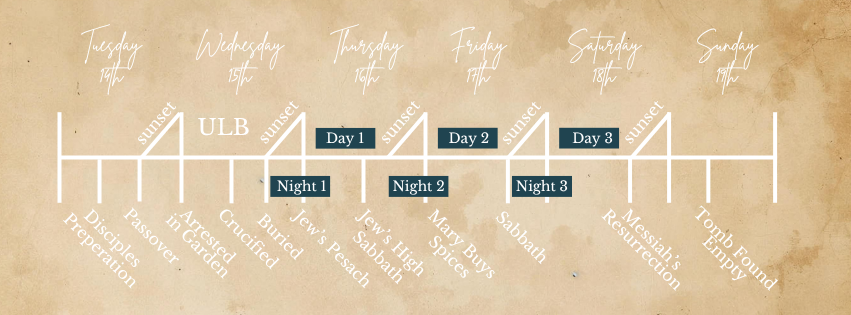
If we consider that He kept the Zadok calendar, the disciples prepared the Passover Tuesday so Messiah would be eating the Passover on Tuesday between the evenings- the 14th transitioning into the 15th - the start of Unleavened Bread. Wednesday would have been the High Sabbath - the day leaven was removed from dwellings. He breathed His last Wednesday afternoon and was buried by sunset. Night number 1. Rabbinic Judaism would be Keeping their Passover that evening and Thursday would have been their High Sabbath- as John 19:31 expresses. Full day number 1, night number 2. Friday, Mary of Magdala and Mary the mother of James bought and prepared spices. Full day number 2, night number 3. The women rested on the Sabbath. Full day number 3. As the Sabbath ended, He was resurrected. On day one of the week, the women went to the tomb to find it empty.
Matthew 28:1 After the Sabbath, at dawn on the first day of the week, Mary Magdalene and the other Mary went to see the tomb.
Mark 16:2 Very early on the first day of the week, just after sunrise, they went to the tomb.
Luke 24:1 On the first day of the week, very early in the morning, the women came to the tomb, bringing the spices they had prepared.
John 20:1 Early on the first day of the week, while it was still dark, Mary Magdalene went to the tomb and saw that the stone had been removed from the entrance.
One of the neat things about the Zadok calendar is that the Feast Days land on Wednesdays…which for a biblical day actually means Tuesday at sunset to Wednesday at sunset. I believe Messiah ate the true Passover and died on the same day, just as Israel ate the Passover and left Egypt on the same day (Exodus 12:51). It aligns perfectly with three days and three nights in the heart of the earth (Matt. 16:4, Jonah 1:17). Many associate His last breath to when the Jews would be preparing to slaughter the lambs, but it also describes an eclipse and the temple veil being torn in two- exposing the priesthood's corruption. This also makes sense knowing He did not adhere to Judaism’s traditions. As we learned above, there were multiple calendars in play during His ministry. Whether it should be labeled as the Zadok calendar or not, I think it’s wise to at least consider that the Messiah kept a calendar different from the Jewish lunar calendar.
In Conclusion
For me personally, the Zadok calendar shows the most consistency. No matter where you are located in the world, you have the ability to witness the sun shifting gates. The constellation that appears where the sun sets will tell you the month; the moon’s phases and times of appearing will tell you the season. This calendar, for me, has the most amount of evidence, and recognizes all of the lights in the expanse as time-pieces.
Genesis 1:14 And God said, “Let there be lights in the expanse of the sky to distinguish between the day and the night, and let them be signs to mark the seasons and days and years.”
Now, does that mean I, or anyone keeping the Zadok calendar is doing it perfectly? No, absolutely not. We do our best with the evidence that we’ve collected and with the observations we are able to make. I will also say, this is not a complete diagnostic breakdown of the calendars- I am not an expert, and there are still parts I don’t completely understand. This is simply meant to be a general overview to share my findings and offer my opinion if it’s desired. I am personally an evidence over tradition person, and from what I have gathered the Zadok calendar does hold the most amount of evidence and corroborates descriptions from the 66-book scriptures. At the end of the day- I do not care what calendar anybody else keeps, I am just glad to see people keeping the feasts and TRYING their best! I pray we all maintain patience and grace with one another as we each continue our studies!
Additional Resources:
Gospel Worth Dying For- Zadokite Calendar Playlist
Fight For Truth- 2026 Zadokite Luminary Calendar
The Calendar of the Dead Sea Scrolls by Dr. Rachel Elior of Hebrew University
Hanging On His Words- Heavenly Calendar
Kingdom In Context- Calendar of Ancient Israel
Children’s Passover to Resurrection Worksheet FREE PDF
When does a day begin? Comparison Chart PDF